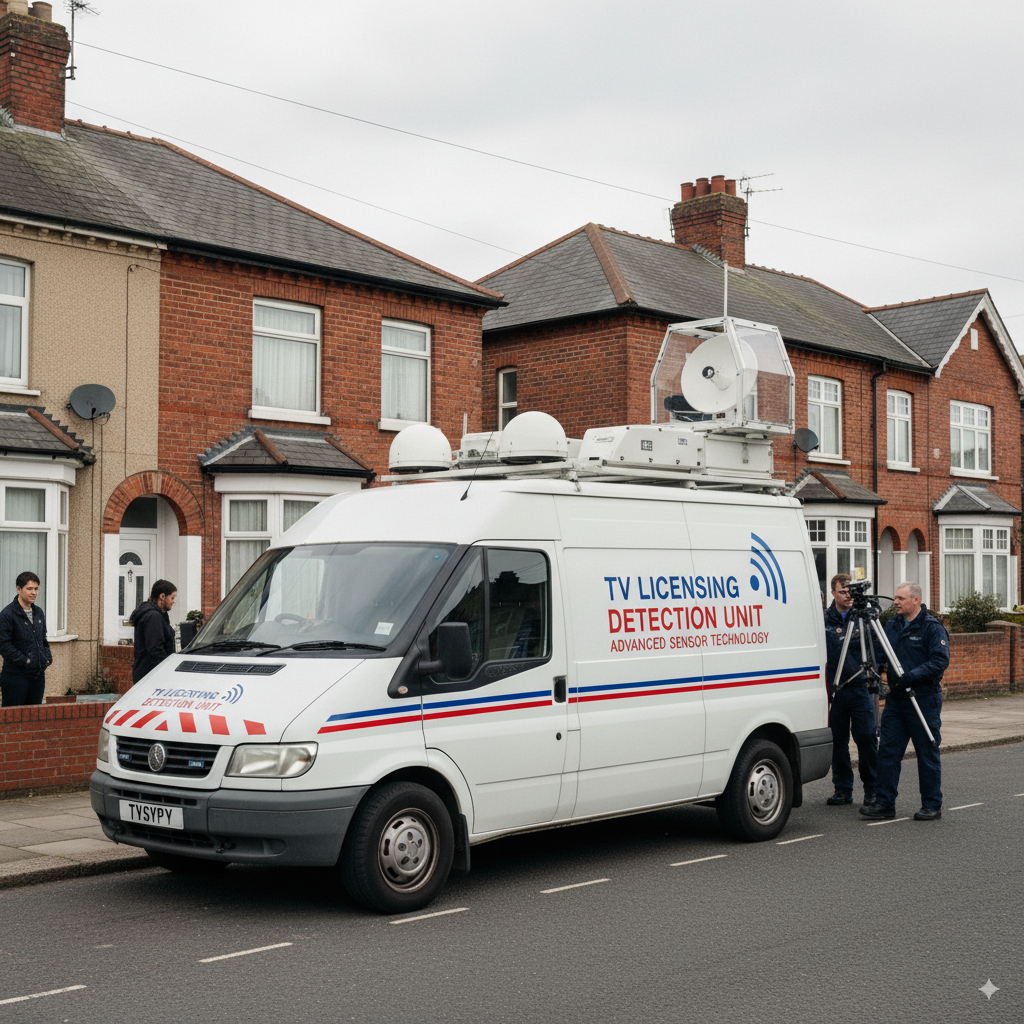
TV Detector Vans
TV detector vans have sparked decades of debate about surveillance, privacy, and enforcement tactics in the UK.
These mysterious vehicles supposedly roamed British streets detecting unlicensed television sets through electromagnetic technology.
TLDR – Key Facts About TV Detector Vans
- First introduced: 1952 by the General Post Office
- Claimed technology: Electromagnetic detection of TV local oscillator emissions
- Detection range: Supposedly several hundred yards
- Current status: Largely considered ineffective or fake by experts
- Primary purpose: Deterrent and publicity tool rather than actual enforcement
- Privacy concerns: Potential surveillance of households without warrants
- Effectiveness debate: No conclusive evidence of successful prosecutions using van detection
TV Detector Vans – Electromagnetic Detection Technology Used for TV Licence Enforcement
TV detector vans are specialised vehicles equipped with electronic equipment designed to detect television sets in operation. The BBC and TV Licensing have claimed these vans can identify households watching television without a valid TV licence.
The fundamental principle behind detector van technology centres on electromagnetic emissions. Every television receiver produces small amounts of electromagnetic radiation during normal operation.
This radiation comes from the TV’s local oscillator circuit. The local oscillator generates frequencies that help convert broadcast signals into viewable images and sound.
How the Detection Process Works
The claimed detection method relies on identifying these electromagnetic signatures. TV detector vans supposedly carry sensitive radio receiving equipment and directional aerials.
Operators can allegedly pinpoint which house contains an operating television. The process involves triangulation from multiple positions to accurately locate the source.
Detection range was claimed to be several hundred yards in optimal conditions. However, in built-up areas with many houses, the effective range dropped significantly.
History and Development from 1952
The Early Years (1950s-1960s)
TV detector vans first appeared in February 1952. The General Post Office, which handled TV licensing before the BBC, demonstrated the first detection vehicle.
These early vans targeted the relatively simple television technology of the era. Black and white televisions used valve technology that produced stronger electromagnetic emissions.
The original detection method focused on the horizontal deflection scanning circuits. These circuits created magnetic fields that could theoretically be detected from outside buildings.
Evolution Through the Decades
As television technology advanced, so did the claimed detection methods. The introduction of VHF broadcasts in the 1960s required new detection techniques.
Colour television arrived in the late 1960s, bringing more complex circuitry. Detector van technology allegedly adapted to identify the additional electronic components.
The 1970s and 1980s saw peak activity for detector vans. TV Licensing heavily promoted their existence through advertising campaigns and media coverage.
| Era | TV Technology | Detection Method | Claimed Success Rate |
|---|---|---|---|
| 1950s-1960s | Valve-based B&W TVs | Horizontal deflection detection | High (claimed) |
| 1970s-1980s | Colour TVs, transistors | Local oscillator emissions | Moderate (claimed) |
| 1990s-2000s | Digital TVs, cable/satellite | Multiple signal detection | Low (questioned) |
| 2010s-Present | Smart TVs, streaming | Wi-Fi monitoring (claimed) | Negligible (disputed) |
Technical Analysis of Detection Methods
Electromagnetic Emission Theory
The scientific basis for TV detection rests on Van Eck phreaking principles. This technique involves intercepting electromagnetic emissions from electronic equipment.
Television receivers generate several types of detectable signals. The local oscillator produces the strongest and most consistent emissions.
Modern TVs emit much weaker signals than older valve-based sets. Solid-state electronics and better shielding have dramatically reduced electromagnetic leakage.
Practical Detection Challenges
Several factors make reliable TV detection extremely difficult in practice. Background electromagnetic noise from other devices creates significant interference.
Mobile phones, computers, microwave ovens, and countless other electronics all emit electromagnetic radiation. Distinguishing TV signals from this electronic chaos proves nearly impossible.
Building materials further complicate detection. Modern construction uses metal-framed windows, foil-backed insulation, and other materials that block electromagnetic signals.
Technical Limitations
- Signal strength: TV emissions are extremely weak beyond a few metres
- Interference: Countless other devices create similar electromagnetic signatures
- Shielding: Modern buildings and TVs have better electromagnetic shielding
- Multiple sources: Identifying specific households becomes impossible in dense areas
The Reality vs Myth Debate
Expert Opinions and Scientific Analysis
Many electronics experts and scientists have questioned the effectiveness of TV detector vans. Professional RF engineers argue that reliable detection is technically impossible under real-world conditions.
“TV detector vans exist, but they do not detect anything. They are just for show. TVL have a database of addresses in the UK with or without a licence.”
The British Army has reportedly stated that even military-grade detection equipment cannot reliably perform the functions claimed by TV Licensing.
Freedom of Information requests have failed to produce concrete evidence of detector van effectiveness. TV Licensing refuses to disclose technical details, citing “commercial sensitivity.”
Lack of Prosecution Evidence
Despite decades of detector van operations, no documented cases exist of prosecutions based solely on van detection evidence. Court cases typically rely on admissions or physical evidence gathered during visits.
TV Licensing statistics show that the vast majority of prosecutions result from door-to-door visits rather than technological detection methods.
The conviction rate remains high, but this stems from people admitting guilt rather than being caught through electronic surveillance.
Privacy Concerns and Surveillance Issues
Constitutional and Legal Questions
TV detector vans raise significant privacy concerns about state surveillance of private homes. The technology potentially allows monitoring of household activities without search warrants.
Human rights advocates have questioned whether electromagnetic surveillance violates privacy protections. The European Convention on Human Rights guarantees respect for private and family life.
The legal framework surrounding detector van operations remains largely secret. TV Licensing provides no clear guidelines about when and how detection technology is deployed.
Data Protection Implications
Modern claims about Wi-Fi monitoring for BBC iPlayer detection raise additional privacy concerns. Intercepting internet traffic potentially violates data protection laws.
The General Data Protection Regulation (GDPR) requires clear legal basis for processing personal data. Electromagnetic surveillance of homes may not meet these requirements.
Surveillance without consent could breach multiple privacy laws if detector vans actually function as claimed.
Key Privacy Concerns:
- Warrantless surveillance: Monitoring homes without judicial oversight
- Bulk data collection: Potentially gathering information about all households
- Lack of transparency: No public information about detection methods or safeguards
- Data retention: Unknown policies for storing surveillance data
Current Status and Modern Enforcement
Digital Age Challenges
The rise of digital television and internet streaming has made traditional detection methods obsolete. Modern viewing habits involve multiple devices and platforms.
BBC iPlayer requires internet access, leading to claims about Wi-Fi monitoring. However, encrypted internet traffic makes content detection extremely difficult.
Smart TVs connect to multiple streaming services, making it impossible to determine if someone is watching BBC content specifically.
Alternative Enforcement Methods
TV Licensing now relies primarily on database analysis rather than detection vans. They cross-reference addresses with licence records to identify potential evaders.
Door-to-door visits remain the primary enforcement tool. Visiting officers gather evidence through interviews and visual confirmation of TV equipment.
Statistical modelling helps identify high-risk addresses. Areas with low licence compliance rates receive increased attention from enforcement teams.
Public Perception and Scare Tactics
Marketing and Propaganda
TV detector vans have been heavily promoted through advertising campaigns designed to encourage licence compliance. The mere suggestion of detection technology acts as a deterrent.
Television advertisements in the 1970s and 1980s featured dramatic footage of detector vans in operation. These ads emphasised the inevitability of being caught without a licence.
The psychological effect of detector van stories often proves more effective than actual detection capability. Fear of surveillance encourages voluntary compliance.
Urban Legends and Folklore
Detector vans have entered British folklore as mysterious government surveillance tools. Stories about their capabilities often exceed realistic technical possibilities.
Social media discussions reveal widespread public uncertainty about detector van effectiveness. Many people remain unsure whether the technology actually works.
Generational differences exist in detector van awareness. Older generations who experienced peak advertising campaigns show higher belief in their effectiveness.
Scientific Assessment of Detection Claims
Electromagnetic Physics
Physics principles governing electromagnetic radiation suggest that TV detection is theoretically possible but practically very difficult. Signal strength decreases rapidly with distance.
The inverse square law means electromagnetic emissions become extremely weak beyond a few metres. Detecting these signals through building walls adds further complications.
Electromagnetic compatibility regulations require modern electronics to minimise emissions. This makes detection even more challenging than with older equipment.
Comparative Technology Analysis
Military surveillance technology capable of detecting electronic emissions does exist. However, this equipment is extremely expensive, sophisticated, and requires specialist operators.
Commercial TV detector vans would need similar capabilities but at much lower cost. The economics of TV licence enforcement make such investment unlikely.
Mobile detection systems face additional challenges from vehicle vibration, electrical interference, and limited setup time at each location.
International Perspectives and Comparisons
Other Countries’ Approaches
Most countries with public broadcasting funding rely on different enforcement methods. Germany uses registration databases, while Nordic countries integrate TV licensing with tax systems.
No other nation has adopted electromagnetic detection for broadcast licence enforcement. This uniquely British approach raises questions about its effectiveness.
International experts in electromagnetic surveillance consider TV detector van claims highly questionable based on technical limitations.
Conclusion: Technology, Privacy, and Public Policy
TV detector vans represent a fascinating intersection of technology, privacy rights, and public policy enforcement. While electromagnetic detection is theoretically possible, practical implementation faces severe limitations.
The ongoing debate about detector van effectiveness highlights broader questions about surveillance, privacy, and government transparency. Modern enforcement methods rely more on data analysis and voluntary compliance.
Future developments in TV licensing enforcement will likely focus on digital tracking and statistical analysis rather than electromagnetic surveillance. The age of the TV detector van appears to be ending, but its legacy in British culture remains strong.
Whether real or myth, TV detector vans have successfully encouraged TV licence compliance through decades of uncertainty and fear of detection. This psychological impact may have been their true purpose all along.